





Introduction
The business case for sustainable energy technologies continues to improve, as exemplified by the now widespread integration of behind-the-meter solar photovoltaic (PV) systems by local governments and businesses alike. As organisations look for ways to further reduce their reliance on grid electricity, installing new solar PV systems, or expanding existing ones, can certainly be a valid strategy in many cases. However while PV opportunities remain a central focus for many of our clients, we are noticing an increasing interest in implementing battery storage solutions – a trend we expect to accelerate in coming years.
To help shed some light on the case for battery storage, this blog post explores the some of the key financial and technical issues to keep in mind when considering if battery storage is right for you.
Eight factors driving interest in battery systems
In our work, we are finding the main factors driving an increase in battery systems are:
- Rising retail energy costs: As energy prices continue to increase in Australia, businesses and councils are looking for ways to reduce their electricity bills, driving interest in battery systems that can store cheaper, cleaner, excess solar power for use during peak pricing periods.
- Decreasing battery prices: The steady decline in battery costs makes battery energy storage systems more affordable and financially attractive, lowering the barrier to entry for both organisations and householders.
- Load profile challenges: Early morning and late afternoon energy demands, which cannot be met by solar alone, is highlighting the need for battery systems to store solar energy generated during the day for use during these peak load times.
- Oversized PV systems: Facilities with PV systems that generate energy in excess of onsite demand are not uncommon. Even with well-sized solar PV systems, substantial exports of solar power can occur at certain times of the year, and on weekends.
- Expanded PV systems: Some organisations may wish to expand existing solar arrays to support building electrification and increased EV uptake, with batteries playing a crucial role in enabling better load management across the site.
- Declining feed-in tariffs: The trend towards lower feed-in tariff rates reduces the financial benefits of exporting excess solar energy to the grid, encouraging the adoption of battery systems to maximise the self-consumption of generated solar power.
- Carbon accounting standards: The recent changes to prevent organisations from claiming exported solar energy from small-scale systems in carbon inventories, including under Australia’s Climate Active standard, pushes organisations to use battery systems to store and consume their solar energy onsite, aiding in carbon footprint reduction.
- Grant funding opportunities: Various government grants and incentives aimed at promoting renewable energy and energy storage are further driving interest in battery systems by reducing the initial capital investment required.
Battery storage applications, technology, and risk management
Battery Energy Storage Systems (or BESS, for short), can prove financially and technically feasible across a range of different types of facilities, including office buildings and administration centres, community buildings, recreation facilities, depots, water utilities, libraries, and holiday parks. At the same time, assessing the case for battery storage on a case-by-case basis is essential due to a range of factors that impact performance and feasibility.
Building energy load profiles differ significantly across facilities, even facilities of the same kind, influencing the appropriate size and configuration of battery equipment. Solar generation and export data needs to be considered to optimise energy storage and discharge potential, ensuring alignment with energy demand. Local site considerations, such as space availability, grid connection points, and regulatory requirements, also play a crucial role in ensuring and optimising overall project feasibility.
Lithium-ion batteries are currently the most common type of energy storage system, dominating the market due to their high energy density, long cycle life, and rapidly decreasing costs. Their versatility and effectiveness make them the preferred choice for a wide range of applications, from small-scale solar storage to large-scale commercial and industrial uses. As the technology continues to improve and economies of scale drive prices down further, lithium-ion batteries are expected to maintain their leading position in the energy storage sector.
However, emerging technologies like sodium-ion and flow batteries are gaining traction as potential alternatives. Sodium-ion batteries are being developed as a more sustainable and cost-effective option, leveraging the abundance of sodium compared to lithium. Flow batteries, particularly vanadium redox flow batteries, are becoming popular for large-scale storage applications where long discharge durations and a longer lifespan are essential. These technologies could play a significant role in diversifying the energy storage market in the decades to come.
Lithium-ion batteries can pose fire risks due to their chemical composition, with hazards arising from overcharging, physical damage, and exposure to high temperatures. Mitigation includes buying reliable brands, regular inspections, and proper installation practices. Batteries also present risks of electric shocks, explosions, and chemical exposure. Adhering to legal standards like the Electrical Safety Act 2002 and the Work Health and Safety Act 2011, along with relevant Australian and international standards (eg AS 1319, AS/NZS 4509.1, and IEC 62109-1), is crucial for safety. Additional risks include bushfires and floods, which require strategic installations, fire-resistant barriers, and comprehensive emergency plans to protect against potential damage and injury.
Sizing for optimal financial performance
Properly sizing a battery system is crucial to maximising efficiency and cost-effectiveness. Oversizing the system leads to unnecessary higher upfront costs without proportional benefits, increasing the payback period, and leading to wasted resources. Undersizing the system can cause insufficient storage capacity, resulting in the inability to meet energy demands during peak times or fully capture available renewable energy, leading to lower energy cost savings in the long run. Correctly sizing the battery ensures it meets the facility’s specific energy needs, optimises return on investment, and prolongs the battery’s operational life.
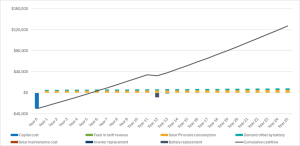
In our work at 100% Renewables we do a lot of work involving modelling the financial performance of combined solar and battery projects. In our experience, well designed systems should be able to pay back investment in around 6 to 8 years. The example shown below is for a combined solar PV and battery installation at a Visitor Centre in regional NSW. In the graph, the black line shows the cumulative cashflow crossing into positive territory and delivering payback after only 6 years.
Emissions reduction potential
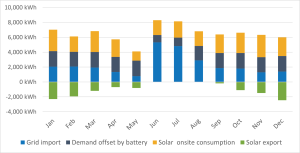
Batteries can play a surprisingly large role in offsetting the need for emissions-intensive grid electricity, and therefore should be considered a serious emissions reduction opportunity. The following example of a solar PV array with a 95kWh battery installed at a council works depot shows that batteries can play as big a role as PV could by itself. It can be seen in the graph below that, for most months of the year, the amount of grid demand offset by battery (dark blue component) is relatively similar in proportion to that offset by solar PV only (yellow component).
Government support
Government grant programs like the Commonwealth’s Community Energy Upgrades Fund (CEUF) can play a crucial role in helping councils get battery projects over the line by providing financial support that reduces the initial capital costs, making these projects more feasible. Round 2 of the Community Energy Upgrades Fund (CEUF) is expected to open in 2025, so it’s advisable for councils to start preparing now to ensure they have well-developed project proposals aligned with funding criteria.
If you need help designing, modelling, or specifying a battery installation, contact us today to learn how we can support you. Reach out to Barbara or Patrick for more information.
Feel free to use an excerpt of this blog on your own site, newsletter, blog, etc. Just send us a copy or link and include the following text at the end of the excerpt: “This content is reprinted from 100% Renewables Pty Ltd’s blog.


 Your download is ready!