





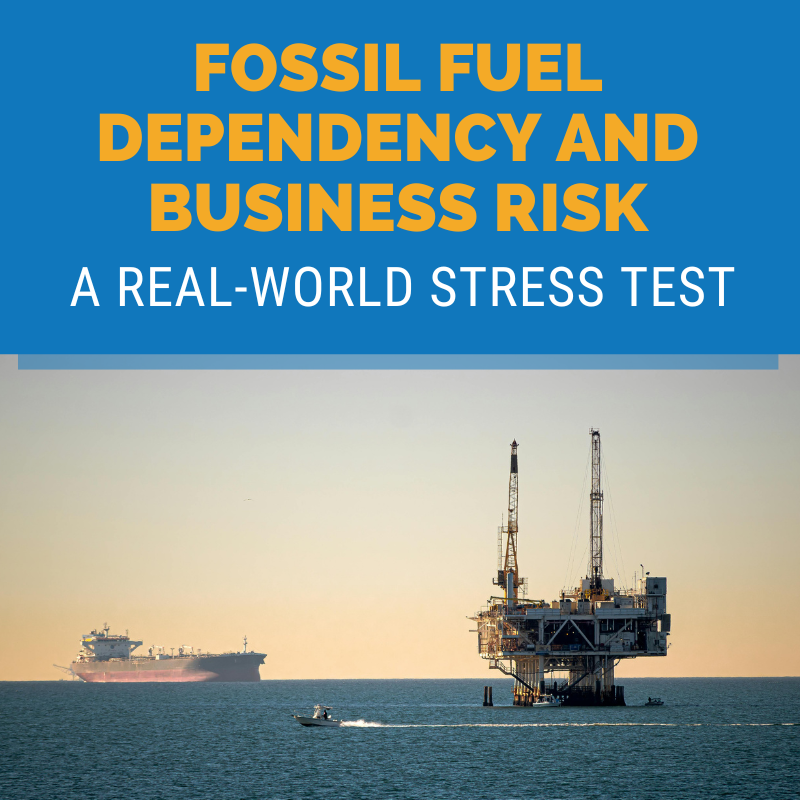
This is what climate risk looks like in real time
The Strait of Hormuz is blocked, and the world is feeling it.
The war in Iran has cut off a chokepoint carrying roughly 20% of global oil supply, and the impacts are already tracking bigger than the 1970s oil crises. Prices have pushed past $100 a barrel, some regions are rationing fuel, and the flow-on effects are moving quickly through food, fertiliser, pharmaceuticals, manufacturing and even the bitumen we use to resurface roads.
This isn’t just an energy problem. It’s running through everything.
There’s a useful way to think about it: our economy is essentially energy transformed. GDP is a rough measure of how much energy we extract, move and use, so when you disrupt the energy supply, you disrupt the economy. It’s fairly direct.
A stress test nobody asked for
Look at which sectors are doing it toughest right now and the pattern is familiar. Road transport and freight operators, farmers running diesel-dependent machinery and buying up fertiliser, construction businesses, council services, and anyone else who moves physical goods or relies on inputs that had to be trucked in from somewhere. Which is, when you think about it, most of the economy.
The pressure isn’t hitting randomly. It’s landing hardest where fossil fuel dependence runs deepest.
Different cause, same problem
Here’s what’s worth noting for anyone working in climate risk: this crisis wasn’t caused by climate change, it was caused by war. But it’s exposing exactly the same vulnerabilities that climate scenario analysis is meant to surface. Supply disruption, price volatility, cascading effects across supply chains. The trigger is different, but the underlying fragility is the same.
Those “unlikely” scenarios? One just happened.
Scenario analysis can be a hard sell internally. The what-ifs tend to feel remote: energy prices spiking, supply chains locking up, key inputs suddenly hard to get. Theoretical, useful for ticking a box, but not something people genuinely expect to see play out.
And then one of those scenarios lands, fast and at scale. That’s the nature of these risks. They don’t give much notice, and the organisations that took the scenarios seriously are in a very different position right now from those that filed the report and moved on.
Transition planning is a resilience exercise, not just a sustainability one
It’s easy to describe a transition plan as a pathway to lower emissions, and that’s true, but it doesn’t capture everything that’s actually in it. A proper transition plan requires an organisation to work out where it’s exposed to fuel costs, supply chain pressure and energy price swings, and then do something about it. That means electrification, renewables, efficiency improvements and getting into the supply chain to understand what’s actually going on upstream.
These aren’t just sustainability initiatives. They’re practical ways to reduce operational risk, and right now, organisations that have made progress on them have a lot more room to move than those that haven’t.
Scope 3 isn’t a reporting problem. It’s a map of where you’re exposed.
A lot of what’s playing out right now isn’t happening inside organisations, it’s happening around them. Suppliers are under pressure, freight is backing up, and customers are pulling back as their own costs climb. In climate terms, this is Scope 3.
Scope 3 tends to get treated as a data headache: hard to measure, hard to influence, mostly something you deal with for disclosure purposes. But situations like this reframe it. Scope 3 is really a picture of where you depend on others, and therefore where things can go wrong when the system is under stress. That’s not a reporting question, it’s a business question.
The risk isn’t off in the distance
Climate risk gets talked about as a long-term challenge, something to manage across decades. But the real vulnerability isn’t the climate itself, it’s dependence on systems that can be disrupted from any number of directions, often without much warning.
Fossil fuel supply chains are one of those systems. They sit at the centre of how our economy functions, so when they come under pressure, the damage spreads rather than staying contained. Building resilience means reducing that exposure, not just against future climate scenarios, but against the kinds of disruptions that tend to arrive sooner than expected.
If your organisation is working through transition planning or climate risk and wants to think about what genuine resilience looks like, reach out to Barbara or Patrick.
Feel free to use an excerpt of this blog on your own site, newsletter, blog, etc. Just send us a copy or link and include the following text at the end of the excerpt: “This content is reprinted from 100% Renewables Pty Ltd’s blog.


 Your download is ready!